
ግዕዝ
The History of Ge'ez
One of the oldest writing systems still in active use — and it started right here in Africa. Three thousand years of history live in every character your child learns.
3,000 Years at a Glance
From ancient inscriptions to your child's tablet — the journey of the Ge'ez script through the centuries.
The Great Innovation: Vowels Added
Small strokes and modifications are added to each consonant to indicate vowel sounds, transforming the script from an abjad into an abugida. The writing direction also shifts from right-to-left to left-to-right. This is the system that survives to this day.
Adapted for Amharic
As the Solomonic dynasty rises, the Ge’ez script is adapted to write Amharic, the new court language. Additional characters are created for sounds not found in Ge’ez. The script is subsequently adapted for Tigrinya, Tigre, and other Ethiopic languages.
Sources: [6]
First Ge’ez Book Printed in Europe
A Ge’ez psalter is printed in Rome, making it one of the first non-European scripts to appear in print. European scholars take increasing interest in Ethiopian manuscripts and the Ge’ez script.
Sources: [7]
Ethiopic Enters Unicode
The Ethiopic script block is added to the Unicode Standard (version 1.1), ensuring Ge’ez-based scripts can be used in digital communication worldwide. Later updates add extensions for additional languages.
Sources: [8]
A Living Script for Tens of Millions
Scripts derived from Ge’ez are used daily by tens of millions of Tigrinya, Amharic, and Tigre speakers across Ethiopia, Eritrea, and the global diaspora. Ge’ez itself remains the liturgical language of the Ethiopian and Eritrean Orthodox Tewahedo Churches.
How the Writing System Works
Ge'ez is an abugida — each character represents a consonant-vowel pair, not a single letter.
The Fidel Grid
33 consonants × 7 vowel forms = 231 characters
Unlike English, where “h” and “a” are separate letters, in Ge'ez the consonant “h” with the vowel “a” is a single character: ሃ. Each consonant has seven forms — one for each vowel.
ሀ
hä
1st (ä)
ሁ
hu
2nd (u)
ሂ
hi
3rd (i)
ሃ
ha
4th (a)
ሄ
hé
5th (é)
ህ
hə
6th (ə)
ሆ
ho
7th (o)
This is just the consonant ሀ (h). Multiply this by 33 consonants and you have the full Fidel.
Explore the full alphabet in our learning appThe Kingdom of Aksum
The script's story is inseparable from one of Africa's greatest ancient civilizations.
A Great Power
At its height (1st–7th century CE), the Kingdom of Aksum was one of the four great powers of the ancient world, alongside Rome, Persia, and China. Its capital lay in what is now northern Ethiopia, near the modern city of Axum.
The Ezana Stone
King Ezana's famous trilingual inscription — carved in Ge'ez, Greek, and South Arabian — records his military victories and his conversion to Christianity around 330 CE. It is one of the most important epigraphic monuments in African history.
A Crossroads of Trade
Aksum controlled the Red Sea port of Adulis and traded with Rome, India, Arabia, and the Mediterranean world. This cosmopolitan character influenced the script's development — Greek and South Arabian influences are visible in its earliest forms.
Christianity & the Script
The adoption of Christianity created a need to translate scripture. This literary impulse drove the addition of vowels to the script and launched a golden age of Ge'ez literature that produced religious texts still in use today.
From Ancient to Modern
Ge'ez evolved into the scripts used by millions today.
Living Descendants
The Ge'ez script was adapted over centuries to write Tigrinya, Amharic, Tigre, and several other languages of the Horn. Each adaptation added characters for sounds not present in Ge'ez itself.
Oromo is also written with Ethiopic characters in some contexts, though most Oromo speakers today use the Latin-based Qubee alphabet.
Why “Fidel”?
The word Fidel (ፊደል) is the Tigrinya and Amharic word for “alphabet” or “letter.” It comes from the Ge'ez root meaning “script” or “writing.”
When we named this app Fidel Family, we wanted every parent and child to feel connected to this ancient tradition. Learning Fidel is not just learning an alphabet — it is inheriting a 3,000-year-old literary culture.
Why It Matters
Ge'ez is more than a script. It is a symbol of continuity, independence, and cultural pride.
Africa’s Most Prominent Indigenous Script
While many African cultures developed writing systems, Ge’ez is one of very few with an unbroken tradition from antiquity to the present. It stands alongside Egyptian hieroglyphs and Tifinagh as a pillar of African literary heritage.
Independently Developed
The Ge’ez script was not imposed by colonizers. While it has roots in the South Arabian script family, its evolution into an abugida — with vowels integrated into each character — was a uniquely Ethiopian-Eritrean innovation.
A Living Liturgical Language
Ge’ez is still used in the liturgy of the Ethiopian and Eritrean Orthodox Tewahedo Churches, making it one of the few ancient languages that has never fully fallen out of spoken use in a religious context.
A Bridge Across Generations
For diaspora families, learning Fidel connects children to a writing tradition older than Latin, Greek, or Arabic. Every character your child traces carries three thousand years of history.
Explore Our History Books
Share these stories with your child — history that shaped a continent, told for young minds.

Kaldi and the Dancing Goats
The legendary tale of how a curious Ethiopian goatherd named Kaldi discovered coffee — the drink that would conquer the world. From the highlands of Ethiopia to cups in every country, follow the incredible journey of the dancing goats' magical red berries.
Ages 8-10
Yared and the Singing Birds
Young Yared is the worst student in his school. His teacher sends him away in disgust. But when a tiny caterpillar teaches him the secret of never giving up, Yared returns to become the greatest scholar in the land — and invents an entire system of music inspired by the songs of birds. His music is still sung in Ethiopian churches fifteen hundred years later.
Ages 6-8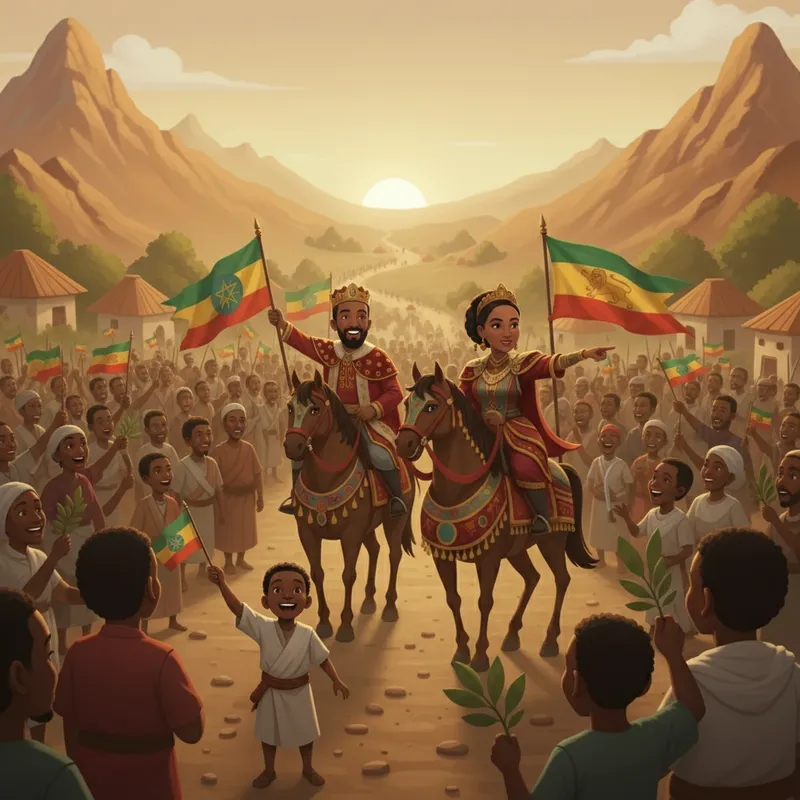
The Battle That Changed Everything
The thrilling true story of the Battle of Adwa, where Ethiopians from every region united to defeat a European colonial army in 1896. Discover how courage, strategy, and unity made history and inspired freedom movements across Africa.
Ages 8-10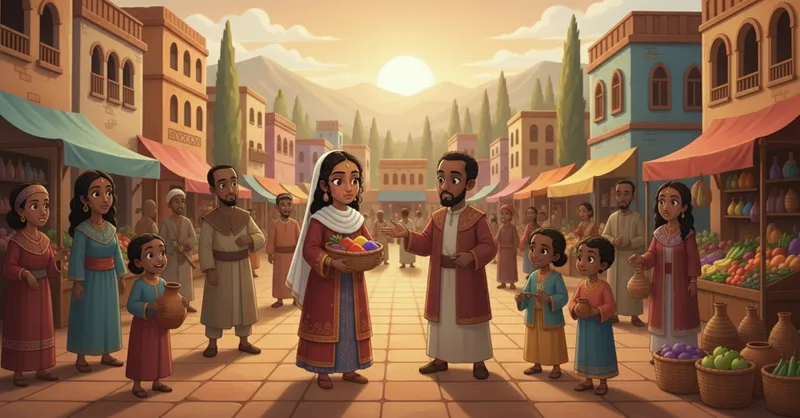
The New Flower
The true story of Empress Taytu Betul, the brilliant strategist and visionary who founded Addis Ababa — Ethiopia's capital city. Discover how one woman's love for hot springs and eucalyptus trees changed the course of history.
Ages 8-10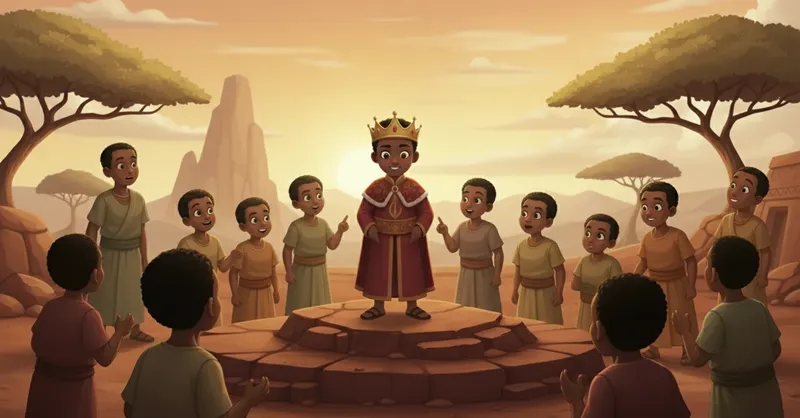
The Church in the Rock
When King Lalibela has a vision of a holy city carved from stone, everyone says it is impossible. But with unshakable faith, tireless workers, and — legend says — angels who carve through the night, eleven extraordinary churches are born from solid rock. A true story of perseverance, vision, and one of the most incredible buildings on Earth.
Ages 6-8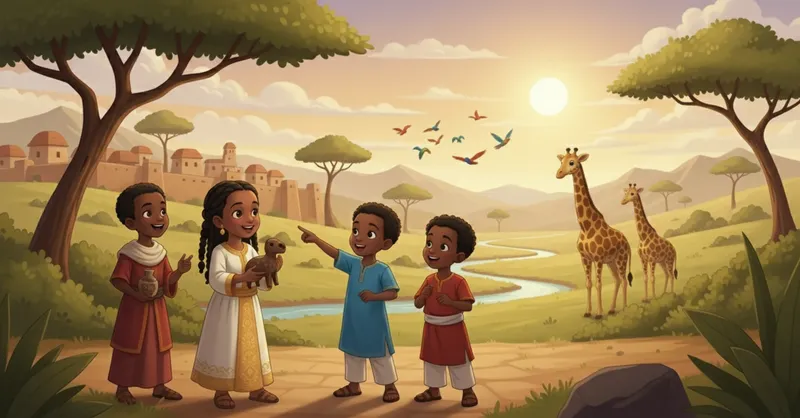
Traders of the Red Sea
Journey to the ancient port of Adulis and the mighty Aksumite Empire, where Ethiopian and Eritrean merchants traded ivory, gold, and frankincense with Rome, India, and Persia over two thousand years ago. Discover Africa's connection to the ancient world.
Ages 8-10References
The historical content on this page is drawn from the following academic sources. We encourage readers to explore them for a deeper understanding.
- [1] Daniels, P.T. & Bright, W. (Eds.). (1996). “The World’s Writing Systems.” Oxford University Press.
Comprehensive reference on the classification and evolution of the Ethiopic writing system. - [2] Phillipson, D.W. (2012). “Foundations of an African Civilisation: Aksum and the Northern Horn, 1000 BC–AD 1300.” James Currey / Boydell & Brewer.
Archaeological and historical evidence for the development of the Ge’ez script from South Arabian predecessors. - [3] Drewes, A.J. (1962). “Inscriptions de l’Éthiopie antique.” E.J. Brill.
Early epigraphic analysis of ancient Ethiopian inscriptions and their South Arabian connections. - [4] Munro-Hay, S. (1991). “Aksum: An African Civilisation of Late Antiquity.” Edinburgh University Press.
Detailed study of the Aksumite Kingdom, including King Ezana’s inscriptions and the adoption of Christianity. - [5] Hahn, W. (2010). “The Coinage of King Ezana.” In: “Encyclopaedia Aethiopica,” Vol. 4. Harrassowitz Verlag.
Numismatic and epigraphic evidence for the timeline of Ezana’s conversion. - [6] Uhlig, S. (Ed.). (2003–2014). “Encyclopaedia Aethiopica,” Vols. 1–5. Harrassowitz Verlag.
The most comprehensive academic reference on Ethiopian and Eritrean studies, including the history and structure of the Ge’ez script. - [7] Ullendorff, E. (1968). “Ethiopia and the Bible.” Oxford University Press.
The role of Ge’ez in biblical translation and early Ethiopian Christian literary culture. - [8] The Unicode Consortium. (1993). “The Unicode Standard, Version 1.1.” Unicode, Inc.
Original specification for the Ethiopic code block (U+1200–U+137F). - [9] Hetzron, R. (Ed.). (1997). “The Semitic Languages.” Routledge.
Overview of the Semitic language family, including the Ethiopic branch and its modern descendants.
Continue the tradition
Three thousand years of writing. Your child's turn to learn.