
How to teach your child the fidel alphabet: a complete guide for Tigrinya and Amharic-speaking families
Fidel — the alphabet used to write Tigrinya, Amharic, and Ge'ez — is one of the most learnable scripts in the world for young children. There are no silent letters. No irregular spellings. No rules to memorize. A child who recognizes a character knows exactly how it sounds. A child who can pronounce a word can write it correctly the first time.
For diaspora families, fidel literacy is the bridge across generations. It is what lets a child read a grandmother's birthday card in the original script. It opens picture books, song lyrics, family letters, and the Tewahedo prayer books that older relatives carry with them. And it preserves a writing system that has been in continuous use since the 4th century.
This guide is the complete framework for teaching the fidel alphabet to your child at home. It covers what fidel actually is, the order in which letters should be taught, the seven vowel forms every child must learn, and a four-stage progression — the Halehame Method — that takes a child from first exposure at age 2 to fluent reading by age 6.
Three rules for raising fidel-literate children in the diaspora
Before the details, the takeaways. Everything else in this guide unpacks these three rules.
1. Audio first, always. Fidel is a phonetic script. A child who has never heard a letter pronounced by a fluent speaker is not learning fidel — they are memorizing shapes. Audio recordings, video calls with relatives, and the recitation song must come before tracing or reading.
2. The Halehame order is non-negotiable. Teaching letters out of the traditional sequence will leave your child unable to follow grandparents, teachers, or any other fidel-literate adult who recites the alphabet. The order is fixed across Eritrea, Ethiopia, and the diaspora; respect it.
3. Every consonant is seven letters, not one. The alphabet is not 33 characters — it is 231. Children who learn only the first-order forms cannot read a single sentence. Plan for the long arc, not the short.
What the fidel alphabet actually is
Fidel (ፊደል) is an abugida — a writing system in which each base consonant has a series of forms representing different vowels. It is sometimes called the Ge'ez script or Ethiopic script in academic and Unicode contexts. The same script is used to write Tigrinya, Amharic, Ge'ez, and Tigre, with small variations in which characters each language uses.
The version of fidel used to write modern Tigrinya and Amharic has 33 base consonants. Each consonant appears in 7 vowel forms (called orders), giving 231 base syllabic characters. Additional characters represent labialized consonants — consonants pronounced with rounded lips, such as ኳ (kwa) — and a small set of language-specific sounds.
Three properties make fidel unusually friendly for young children:
- Each character is a syllable. A child who recognizes ቡ knows it says bu. There is no decoding step — no breaking the symbol into smaller parts. This is the cognitive opposite of English literacy.
- Spelling is regular. Words are written exactly as they sound. A child who knows the symbols can read any word they can pronounce, and write any word they can hear.
- The system is small and self-similar. The 7 vowel forms are produced by adding small marks to a base consonant shape. A child who learns the rule for forming the u-sound (2nd order) on one consonant can apply it to all 33.
For comparison: English-literate children spend roughly 18 months mastering the relationship between 26 letters and ~44 phonemes, complicated by silent letters, digraphs, and irregular spellings. Fidel-literate children spend roughly 12 months mastering 231 characters with no exceptions. The total cognitive load is similar; the distribution is dramatically different.
The Halehame order: the only way to teach the alphabet
Fidel is taught in a fixed sequence called the Halehame order, named after its first four letters: Ha, Le, Ha, Me. Children, schoolchildren, and adult learners across Eritrea, Ethiopia, and the diaspora all learn the alphabet in this same sequence. There is a traditional recitation song that sets the order to a simple melody; in Eritrean and Ethiopian schools, children sing it daily until it is automatic.
The first ten consonants in the Halehame order:
| # | Letter | Sound | Notes |
|---|---|---|---|
| 1 | ሀ | ha | The default, light h. |
| 2 | ለ | le | A clean, dental l. |
| 3 | ሐ | ḥa | A deeper, throatier h than #1. Modern speech often merges #1 and #3. |
| 4 | መ | me | Standard m. |
| 5 | ሠ | śe | Historically distinct from #7; now identical in modern speech. |
| 6 | ረ | re | A trilled or tapped r. |
| 7 | ሰ | se | Standard s. |
| 8 | ሸ | she | English sh. |
| 9 | ቀ | qe | A uvular k with no English equivalent. The back of the tongue closes against the soft palate. |
| 10 | በ | be | Standard b. |
The remaining 23 consonants follow in the same fixed order. Every fidel-literate adult has memorized the complete sequence — your child should too.
Why the order matters. The Halehame sequence is not random. Letters that share visual features tend to be grouped together (the ha family, the m/s family). The order is encoded in the recitation song, in school workbooks, in printed alphabet charts, and in the muscle memory of every fidel-literate adult. A child taught out of order will be unable to follow along when a grandparent recites the alphabet, and the disconnect is hard to repair later.
The recitation song is the single best resource for ages 2–4. Search "halehame song" on YouTube. Play one version on repeat for a week. Your child will know the order without ever being formally taught it. This is how Eritrean and Ethiopian children have learned for centuries.
The seven vowel forms (orders)
Every consonant in fidel has 7 forms, called orders (Amharic: ዘር; pronounced zer). Each order combines the consonant with one of seven vowels. The orders are fixed across the entire alphabet: the rule for transforming a consonant into its 2nd-order form is the same for ሀ as it is for ፐ.
| Order | Vowel | ha | le | me | be |
|---|---|---|---|---|---|
| 1st | ä (default) | ሀ | ለ | መ | በ |
| 2nd | u | ሁ | ሉ | ሙ | ቡ |
| 3rd | i | ሂ | ሊ | ሚ | ቢ |
| 4th | a (long a) | ሃ | ላ | ማ | ባ |
| 5th | e | ሄ | ሌ | ሜ | ቤ |
| 6th | ə (short, neutral) | ህ | ል | ም | ብ |
| 7th | o | ሆ | ሎ | ሞ | ቦ |
Read across any row: that is the same vowel applied to four different consonants. Read down any column: that is the same consonant with seven different vowels. Children should learn down the columns, one consonant at a time, before they read across the rows.
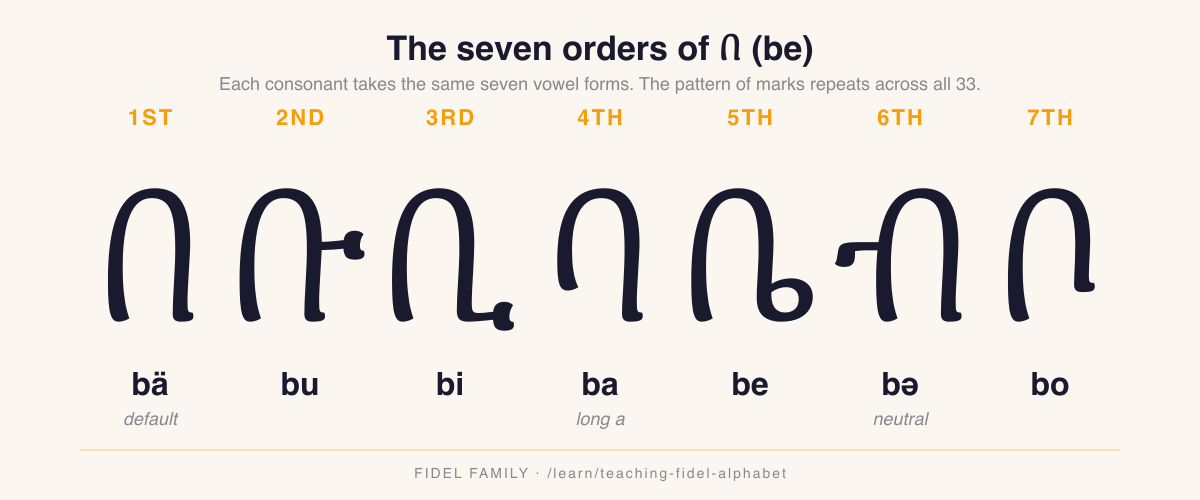
The diagram above shows what is happening structurally: the base consonant በ keeps its core shape across all seven forms, and each order adds or modifies a small mark to indicate the vowel. A child who learns to recognize the u-mark on one consonant can predict how it will look on every other. This is why fidel scales: 33 consonants × 7 vowel marks is a cognitively small system, not a memorization marathon.
The 6th-order form (the ə form) is the only one that requires special attention. The vowel is short and neutral — barely pronounced — and it is most commonly used as a stand-alone consonant cluster in writing. The English approximation is the uh in button. Children find it confusing the first time; flag it explicitly when you introduce it.
The 4th-order form (the long a) is the second most common after the 1st order. It appears in many family-related words: ማማ (mama), ባባ (baba), ሃገር (hagar, the long-vowel form sometimes used in Tigrinya).
The Halehame Method: a four-stage progression
The Halehame Method is the four-stage framework that takes a child from first exposure to fluent reading. Each stage has a target age range, a focus, a milestone, and a failure mode to avoid. Move to the next stage only when the milestone is met — but do not rush; younger children benefit from extra time at each stage.
Stage 1: Listen (ages 2–3)
Focus: Audio exposure. The child hears fidel sounds attached to fidel shapes long before they can recognize either. Activities: Play the Halehame recitation song daily. Watch fidel alphabet videos. Have a grandparent recite the alphabet over video call. Point at letters in books, on packaging, on signs, and say their names aloud. Milestone: The child can sing along with the first 10–15 letters of the recitation song. What success looks like: A 3-year-old who, when shown the letter ሀ, says "ha" without being prompted. Failure mode to avoid: Teaching letters silently (worksheets without audio). Fidel without sound is not fidel.
Stage 2: Trace (ages 3–4)
Focus: Muscle memory. The child traces each first-order character with their finger, on paper, on a screen, or in the air. Activities: Tracing workbooks. Sand or salt trays. Finger-tracing on a tablet. Drawing letters in chalk on a sidewalk. The medium does not matter; the repetition does. Milestone: The child can trace the first 10 first-order letters in correct stroke order without prompting. What success looks like: A 4-year-old who, asked to write ha, draws ሀ correctly and says the sound while drawing. Failure mode to avoid: Skipping stroke order. Each letter has a conventional sequence of strokes; writing letters in the wrong order produces messy, unreadable handwriting that is hard to correct later.
Stage 3: Recognize (ages 4–5)
Focus: Reading individual characters out of order, including the seven vowel forms. The child looks at a letter and names it without hesitation. Activities: Flashcards (paper or digital). Letter-matching games. Reading the alphabet chart in random order. Spotting specific letters in family names and familiar words. Milestone: The child can read all 33 first-order forms in any order, and at least the 1st, 4th, and 6th orders of the first 10 consonants. What success looks like: A 5-year-old who, shown ቤ (be, 5th order), says "be" and recognizes it as the b family. Failure mode to avoid: Stopping at the first-order forms. The child has learned 33 of 231 characters and cannot read a single word.
Stage 4: Read (ages 5–6)
Focus: Reading whole words, then whole sentences, then whole books. Activities: Picture books with simple text. Reading family names. Decoding food packaging written in fidel. Writing short notes to grandparents. Reading aloud at family meals. Milestone: The child can read a one-sentence picture book page without help. What success looks like: A 6-year-old who reads አባ ይመጣ (aba yimäṭa, "Daddy is coming") aloud and understands the meaning. Failure mode to avoid: Treating reading as a test rather than a shared activity. Reading mistakes should be corrected gently and immediately. Praise the attempt, not the outcome.
The full progression takes 3–4 years for most children. Children who start at 2 and have daily fidel exposure typically reach Stage 4 by age 6. Children who start later catch up quickly because the cognitive load is small once audio is established.
A 30-day starter plan
If you have not started yet and want a concrete first month, this is the plan. It assumes 10–15 minutes a day of focused practice plus passive audio exposure (the recitation song playing in the car or during meals).
Week 1: Audio saturation
- Daily: Play the Halehame recitation song twice through (morning and evening).
- Daily: Sit with your child for five minutes and recite the first ten letters together. Use an alphabet chart or open the fidel.family app.
- Once this week: Schedule a video call with a fluent-speaking relative — grandparent, aunt, uncle. Ask them to recite the alphabet for your child.
- Goal: By Sunday, your child recognizes the song and can sing along with the first three or four letters.
Week 2: First five letters
- Daily: Focus on five letters: ሀ, ለ, ሐ, መ, ሠ. Show each one, say it, have your child repeat it.
- Daily: Trace each letter once on paper or screen. Use chunky markers or a finger on a tablet.
- Three times this week: Read a children's book aloud (in any language). Point out any fidel character your child recognizes from this week's set.
- Goal: By Sunday, your child can name all five letters when shown them in order.
Week 3: Next five letters and recognition
- Daily: Add ረ, ሰ, ሸ, ቀ, በ. Now you are working with the full first ten.
- Daily: Trace each new letter. Review the previous five.
- Twice this week: Mix up the order. Show the ten letters one at a time in random order; ask your child to name each.
- Goal: By Sunday, your child can read all ten first-order letters in any order.
Week 4: First vowel form (the u form)
- Daily: Introduce the 2nd-order form (the u form) for the first five letters: ሁ, ሉ, ሐሁ, ሙ, ሡ.
- Daily: Teach the rule for the u form (a small mark added to the right). Notice how the rule is the same for every letter.
- End of the week: Read a simple word that uses these characters, such as ሙዚቃ (muziqa, music) — even if your child only recognizes one or two letters in the word.
- Goal: By Sunday, your child understands that each consonant has multiple forms and can name the u form for at least three consonants.
After 30 days, you have established the daily habit, audio saturation, and the first ten consonants in their first two vowel forms. From here, the pattern repeats: add five new consonants each week, add a new vowel order every two weeks, and let the child's pace dictate the speed.
What to teach first: the highest-leverage characters
If you only have time to teach a small subset of fidel — perhaps because your child is older and you want to compress the learning, or because you are starting from zero yourself — focus on the first ten consonants in their first-order forms plus the 4th-order forms (the long a) of the same ten. These twenty characters appear in a disproportionate share of common Tigrinya and Amharic words.
Anchor each character to a word your child already knows in the language:
- ሀ → ሀገር (hagar, country)
- መ → መኪና (mekina, car)
- ሰ → ሰላም (selam, peace / hello)
- ለ → ቀለም (qelem, pen) — uses ለ in 1st order
- ቡ (2nd order of በ) → ቡና (buna, coffee)
- ማ (4th order of መ) → ማማ (mama)
- ባ (4th order of በ) → ባባ (baba)
- አ → አባት (abat, father)
- ና (4th order of ነ) → ናና (nana)
- ቤ (5th order of በ) → ቤት (bet, house)
Children learn fidel best when each character is connected to a person, food, or familiar object. Do not teach letters in isolation; teach them attached to meaning.
Common mistakes parents make
A few patterns we see in diaspora families, with what to do instead.
Skipping the Halehame order. Some parents try to teach letters by visual similarity (round letters first) or by frequency (most common letters first). This produces a child who cannot follow grandparents, teachers, or any printed alphabet chart. Do this instead: respect the traditional sequence. Even if it feels arbitrary, it is the shared protocol.
Teaching only the first-order forms. It is tempting to stop at the 33 first-order characters because the child can name them all. But fidel is a 231-character syllabary; first-order-only literacy is non-literacy. Do this instead: by Stage 3, introduce the 4th and 6th orders alongside the first.
Latin transliteration as the lead. Showing "ha = ሀ" with the Latin first teaches the child to read the Latin and look up the fidel afterwards. Do this instead: show ሀ first, say "ha", and let the Latin be the support, never the primary.
Silent practice. Worksheets without audio teach children that fidel is decoration, not language. Do this instead: every tracing session, every flashcard, every alphabet chart should be accompanied by spoken pronunciation by a fluent speaker.
Treating it like English literacy. English literacy is decoding; fidel literacy is pattern recognition. The cognitive task is closer to learning Chinese characters or Japanese kana. Do this instead: short, frequent sessions (5–10 minutes daily) work better than long teaching sessions (30+ minutes weekly).
Stopping when the child resists. All children resist new learning at some point. Do this instead: shrink the session, change the medium (paper to screen, screen to song, song to a video call with grandma), but do not skip. Daily exposure is what compounds.
Common worries from diaspora parents
Six worries we hear over and over, with honest answers.
"I do not speak Tigrinya or Amharic myself. Can I still teach my child fidel?" Yes. Fidel is regular enough that you can learn alongside your child. Audio recordings carry the pronunciation; tracing tools carry the form; picture books carry the meaning. Many diaspora parents who started not knowing fidel are reading at their child's level within 6–12 months of consistent practice.
"My partner does not speak the language. Will the child be confused?" No. Children handle multiple languages without confusion as long as the languages have clear domains. Make fidel time a specific, recognizable ritual — same time of day, same activity, same person leading it. The child will compartmentalize naturally.
"Grandparents are far away and we only see them once a year." Video calls are not a substitute for in-person presence, but they are extraordinarily effective for fidel learning specifically. Grandparents reciting the alphabet over FaceTime, reading a picture book aloud, or correcting the child's pronunciation builds emotional connection to the script in a way no app can. Schedule 15-minute fidel calls weekly.
"My child resists. They want to read English instead." English is everywhere; fidel is rare. The child's resistance reflects the asymmetry of exposure, not a preference. Reduce the English-fidel ratio in their environment (heritage music, fidel picture books, community events), and make fidel time short and consistent rather than long and confrontational.
"We started teaching English first. Are we too late?" No. Children acquire scripts well into elementary school. The optimal start is age 2; the workable start is any age before 8. Diaspora parents who started teaching their child fidel at 5 or 6 routinely report fluent reading by 8.
"There is no fidel community where we live." Build one online. Habesha parent groups on Facebook, WhatsApp groups for diaspora families, video calls with relatives, and in-app communities (such as the Fidel Family book club) are functional substitutes for an in-person community. The most important community member is one fluent speaker who reads with the child weekly; the rest can be remote.
Materials and tools
A short, opinionated list. Each of these is high-leverage; the rest is noise.
Audio recordings of fluent speakers. The single most important resource at every stage. Free recordings exist on YouTube and Spotify. The Fidel Family app includes audio for every letter in all 7 orders, recorded by Tigrinya and Amharic native speakers from Eritrea, Ethiopia, and the diaspora.
A Halehame recitation song. Search YouTube for "halehame song" or "fidel song for kids." Pick one version and play it daily. Children learn the order through melody before they learn it through study.
A printed fidel chart. A wall chart showing all 33 consonants in all 7 orders. Hang it where the child sees it often — bedroom, kitchen, bathroom. Available from Eritrean and Ethiopian community shops, online stores, and as a free download from fidel.family/fidel.
A digital tracing tool. Tablet apps that let the child trace each letter and hear the pronunciation are the most efficient way to build muscle memory. The Fidel Family app includes guided tracing for every consonant.
Picture books in fidel. Heritage-language picture books are the highest-leverage learning material at any stage. They connect letters to story, story to memory, memory to language. The Fidel Family bookstore and several independent publishers offer titles in Tigrinya and Amharic.
A fluent-speaking relative on speed dial. Not optional. Schedule weekly fidel video calls. Make it a ritual.
Frequently asked questions
At what age should we start? Around age 2 for audio exposure and the recitation song. Around age 3 for tracing. Around age 4–5 for recognition. Around age 5–6 for full reading. Children younger than 2 enjoy hearing the song but should not be expected to recognize letters.
How many characters does my child need to learn to read fluently? The complete fidel set used for Tigrinya and Amharic is 231 base characters (33 consonants × 7 orders), plus a small number of labialized consonants and language-specific characters. A child who knows the full 231 plus the most common labialized forms can read any modern Tigrinya or Amharic text.
Should we start with Tigrinya, Amharic, or Oromo? Tigrinya and Amharic both use the fidel alphabet, with small differences in which characters each language emphasizes. Start with whichever language a parent or grandparent speaks fluently. Modern Oromo is most often written in the Latin-based Qubee alphabet rather than in fidel; if the family speaks Oromo, learning Qubee is usually the practical choice.
Is fidel hard to learn? No. The script is small, perfectly phonetic, and regular. Children who start at age 2 typically read simple sentences by age 6. Adults committing 30 minutes a day usually read fluently within 3–6 months.
Can a parent who does not read fidel teach it to their child? Yes. The script is regular enough that a parent can learn alongside the child. Audio recordings, tracing tools, and illustrated picture books reduce the burden on the parent.
Why do some letters look almost identical? Fidel letters are formed by attaching small marks to a base consonant shape to indicate the vowel. Letters that share a base consonant (a single character family) will look very similar across the 7 orders. This is a feature, not a flaw — it means a child who recognizes a base consonant can predict the form of new letters in that family.
Where can I find a complete chart of all 231 characters? A complete fidel chart is available at app.fidel.family/fidel, which displays every consonant and every vowel form with audio for each. Printed charts are available in Eritrean and Ethiopian community shops.
What if my child mixes up similar-looking letters? Expected and temporary. Letters within the same consonant family (e.g. ሀ, ሁ, ሂ, ሃ, ሄ, ህ, ሆ) will be confused at first because they differ by small vowel marks. The fix is repeated exposure, not extra correction. Children who see each letter in context across many words sort the family out within weeks.
How long until my child reads fluently? With daily exposure, 3–4 years from age 2. Children who start later compress the timeline. Reading complex texts (chapter books, religious texts, news) takes additional years; that is true of any literacy.
About this guide
This guide was written by Dino Yemane, founder of Fidel Family. Dino is an Eritrean-American software engineer building heritage-language tools for diaspora families.
Fidel Family is a free language-learning app for children, developed in collaboration with native Tigrinya and Amharic speakers from Eritrea, Ethiopia, and the global diaspora. The app teaches the fidel alphabet through audio, tracing, vocabulary packs, and illustrated picture books — in Tigrinya, Amharic, English, and Oromo.
The app's mission is simple: every Habesha child in the diaspora should be able to read their grandparents' birthday cards in the original script.
This guide reflects the pedagogical approach used in the Fidel Family app, which was developed in conversation with diaspora parents, native-speaker educators, and traditional fidel instruction methods used in Eritrean and Ethiopian schools. Corrections, additions, and questions are welcome at [email protected].
The fidel alphabet has been continuously written, read, and taught for more than 1,600 years. Every fidel-literate child is one more person who can read what their grandparents wrote.